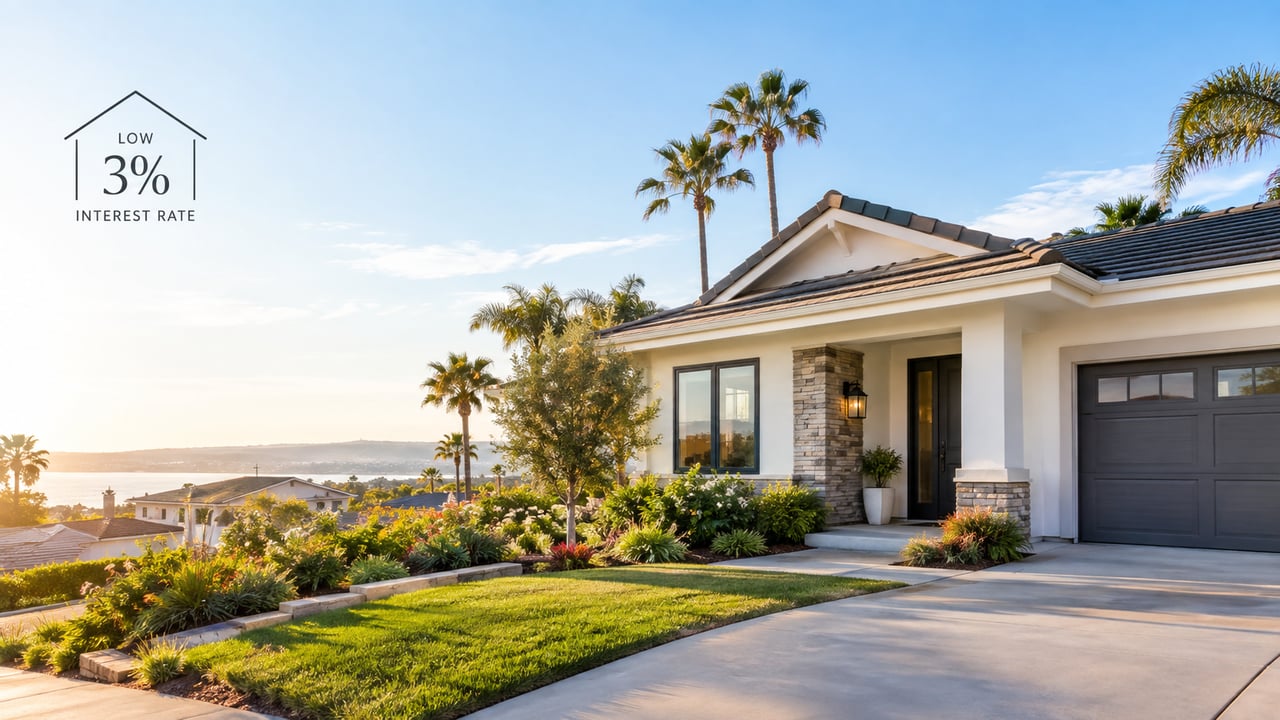
Assumable Loans in San Diego: How to Buy a Home With a 3% Mortgage Rate
Home Buying Tips Alyssa L. Davies September 22, 2026
Home Buying Tips Alyssa L. Davies September 22, 2026
What if you could buy a home in San Diego and keep the seller's existing mortgage rate instead of getting a new loan at today's rates?
It's possible, and I've done it myself.
I purchased my own home by assuming the seller's VA loan. Since then, our team at NewTown Real Estate has closed three additional loan assumption transactions for buyers and sellers in San Diego County.
I can tell you from experience that these transactions can be an incredible opportunity, but they aren't always simple. There are a few things buyers need to understand before getting excited about a seller's 2.75% interest rate.
The biggest one? You still have to figure out how to pay for the rest of the house.
With so many San Diego homeowners holding mortgages from the years when interest rates were historically low, I think assumable loans deserve a lot more attention than they're getting.
Here's how they work, what I've learned from actually closing these transactions, and what I recommend buyers and sellers consider before pursuing one.
An assumable mortgage allows a buyer to take over the seller's existing home loan rather than obtaining an entirely new mortgage.
Instead of paying off the seller's mortgage at closing, the buyer assumes responsibility for the remaining loan balance under the existing terms, subject to the required approval.
That means the buyer may inherit:
The seller's existing interest rate
The remaining loan balance
The remaining repayment period
The existing monthly principal and interest payment
For example, if a seller has a VA loan with a 3% interest rate and 25 years remaining, a qualified buyer may be able to take over that mortgage with the same rate and remaining term.
The loan does not restart with a new 30-year repayment period.
And in a market like San Diego, where even a relatively modest home purchase can involve hundreds of thousands of dollars in financing, the difference between a 3% mortgage and a 6% mortgage is significant.
The three primary types of assumable home loans are VA, FHA, and USDA loans.
Most conventional mortgages contain due-on-sale provisions that require repayment when the property transfers to a new owner. There are certain exceptions, but those are generally not the type of assumption opportunity we're talking about here.
For buyers looking to purchase a home in San Diego, VA and FHA loans are where I would start looking.
Let's look at the math.
Imagine you're purchasing a home with an existing $480,000 mortgage balance.
The seller has a 3% fixed interest rate with 25 years remaining.
Here's what the monthly principal and interest payments would look like if you assumed that mortgage versus financing the same $480,000 over the same 25-year period at 6%.
Assumed mortgage at 3%: Approximately $2,276 per month.
New mortgage at 6%: Approximately $3,093 per month.
That's a difference of approximately $817 per month, or nearly $9,800 per year.
That's a meaningful difference in a household budget.
And this is exactly why I think buyers should investigate loan assumptions before automatically assuming their only option is a new mortgage.
But there is an important distinction.
A lower interest rate doesn't automatically mean the entire purchase is less expensive.
You have to account for the remaining mortgage balance, any additional financing, closing costs, property taxes, insurance, and the amount of cash required to complete the purchase.
The example above compares principal and interest on identical loan balances and repayment periods. It does not include those additional costs.
This is where understanding the full transaction becomes important.
This is probably the biggest misconception I hear about VA loan assumptions.
You do not have to be a veteran to assume an existing VA mortgage.
A qualified civilian buyer can assume a VA loan as long as the buyer meets the applicable credit and income requirements and the assumption receives the necessary approval.
That means someone who has never served in the military may be able to purchase a San Diego home and take over the seller's existing VA mortgage.
Given the number of military homeowners throughout San Diego County, this is an option I want more buyers to understand.
But there are a few things you need to know before making an offer.
An assumable loan is not a way to avoid underwriting.
The buyer must submit an application through the existing loan servicer, which is the company responsible for administering the seller's mortgage.
The servicer will generally evaluate your income, assets, debts, and creditworthiness.
You'll need documentation similar to what you would provide when applying for a traditional mortgage.
My advice is to get your financial documents organized before pursuing an assumption, especially if you're also planning to use a second mortgage to cover the difference between the loan balance and purchase price.
The VA assumption funding fee is 0.5% of the outstanding loan balance for borrowers who are not exempt.
On a $480,000 mortgage, that's $2,400.
For comparison, a new VA purchase loan generally carries a funding fee ranging from 1.25% to 3.3%, depending on the borrower's circumstances.
Some eligible veterans, service members, and surviving spouses qualify for funding fee exemptions.
Buyers should also budget for applicable assumption processing fees, escrow, title, and other allowable closing costs.
This is one of the most important considerations for military homeowners.
If a veteran sells their property to a non-veteran buyer who assumes the existing VA loan, the seller's VA entitlement generally remains tied to that mortgage until the loan is paid off.
The seller can receive an approved release from personal liability for the assumed mortgage without having their entitlement restored. Those are two different things.
If an eligible veteran assumes the loan and substitutes sufficient VA entitlement, the original seller may be able to have their entitlement restored through that process.
Why does this matter?
Because the seller may want to purchase another home using VA financing.
Having entitlement tied to the existing mortgage could affect how much VA loan benefit remains available for their next purchase.
If you're selling a home with a VA loan, I recommend discussing entitlement with a knowledgeable VA lender before you start advertising your mortgage as assumable.
You need to understand how the assumption could affect your next move.
VA loans aren't the only option.
FHA and USDA mortgages can also be assumable, although their specific requirements differ.
FHA assumptions follow a similar general process.
The buyer applies through the existing mortgage servicer and must meet the applicable qualification requirements.
FHA increased its maximum allowable assumption processing fee from $900 to $1,800 in 2024.
Buyers should also understand any mortgage insurance obligations associated with the existing FHA loan and include those costs when comparing financing options.
For buyers considering older San Diego homes purchased with FHA financing, it's worth asking whether an assumption is available.
USDA loans can also be assumed, subject to the applicable program requirements.
However, USDA financing comes with additional considerations involving the type of loan, property eligibility, borrower eligibility, and the terms of the assumption.
Not every USDA assumption preserves the seller's original interest rate.
USDA financing is also more geographically limited in San Diego County because of the program's rural-area eligibility requirements.
If you're considering homes in more rural portions of East County or North County, USDA financing is worth investigating.
This is the part I want every buyer to understand before falling in love with an assumable loan.
You're assuming the seller's remaining mortgage balance, not borrowing the entire purchase price.
Let's use a realistic San Diego example.
Example: Buying a $750,000 Home With an Assumable Mortgage
Purchase price: $750,000
Existing assumable mortgage: $480,000
Seller's interest rate: 3%
Remaining loan term: 25 years
Amount the buyer still needs to cover: $270,000
The buyer needs to figure out how to cover that $270,000 difference, plus applicable closing costs.
And no, you generally cannot simply increase the existing assumed mortgage to cover it.
This is where some otherwise attractive assumption opportunities fall apart.
The interest rate looks incredible, but the buyer doesn't have enough cash or an acceptable financing structure to complete the purchase.
Fortunately, there are potential solutions.
This is the most straightforward approach.
If you have sufficient available funds, you can pay the difference between the purchase price and existing loan balance in cash.
But I wouldn't recommend draining your savings just to secure a lower mortgage rate.
You still need to account for closing costs, repairs, moving expenses, and emergency reserves.
A house with a great mortgage rate isn't much fun if you've left yourself with no financial breathing room.
This is where things can get interesting.
Some lenders offer second mortgages specifically designed to help buyers complete loan assumption transactions.
Using our $750,000 home example, the financing could potentially look like this:
Assumed first mortgage: $480,000
New second mortgage: $200,000
Buyer cash: $70,000
Total purchase price: $750,000
The buyer keeps the seller's existing 3% first mortgage and obtains a separate second loan at the rate and terms available through the new lender.
That second loan will generally carry a different interest rate and repayment period.
The buyer must qualify for both payments.
But not every lender offers this type of financing, and not every proposed second mortgage will be acceptable to the existing servicer.
This is one of the reasons I recommend having the financing conversation early.
You don't want to get into escrow and discover halfway through the transaction that nobody has figured out how you're actually paying for the house.
In certain situations, a seller may be willing to carry part of the purchase price as a second mortgage.
This is less common and requires careful structuring, but it can be an option when the seller has substantial equity and the transaction makes sense for both parties.
The assumed loan's servicer must also accept the proposed financing arrangement.
I wouldn't approach every assumable property expecting seller financing, but I also wouldn't dismiss it without understanding the seller's goals.
Sometimes there's room to structure a transaction differently than a traditional purchase.
This is another area where I want buyers and sellers to have realistic expectations.
Loan assumptions can take longer than traditional mortgage transactions.
The existing loan servicer is responsible for processing the assumption, and that servicer may not have the same systems, staffing, or urgency as a lender originating a brand-new purchase loan.
For planning purposes, I would approach a loan assumption with a potential 60 to 120-day timeline until the servicer gives us a more reliable estimate.
Some transactions move faster.
Others take longer.
The important thing is that everyone involved understands the process before going under contract.
If you're selling a home and need to close in 21 days to purchase your next property, an assumption may not fit your timeline.
If you're a buyer competing against someone offering a quick cash close, you'll need to consider whether the seller is willing to wait.
That's why I would rather have this conversation before writing an offer than try to solve it after escrow opens.
Here's where I think a knowledgeable real estate agent can make a difference.
A home doesn't necessarily have to be marketed as having an assumable mortgage for the opportunity to exist.
Many sellers don't realize their loans may be assumable.
And plenty of listing agents aren't actively advertising the possibility.
If I were searching for a home specifically with an assumable mortgage, this is the process I would follow.
Step 1: Identify homes that may have existing VA, FHA, or USDA financing.
Start by looking for properties that may have eligible financing in place. Homes purchased or refinanced during the years when mortgage rates were historically low are particularly interesting.
Step 2: Find out if the seller is open to an assumption.
Just because the loan may be assumable doesn't mean the seller is interested in going through the process.
Step 3: Confirm the existing mortgage details.
With the seller's permission, we need to verify the outstanding loan balance, interest rate, remaining repayment period, and loan servicer.
Step 4: Confirm the assumption requirements.
Before making an offer dependent on the assumption, we should understand what the servicer requires and what timeline to expect.
Step 5: Determine how to cover the equity gap.
This is where we evaluate cash, second mortgage options, and the buyer's overall financial situation.
Step 6: Compare the assumption against traditional financing.
We need to look at the actual monthly payment, total cash required, closing costs, and financing terms.
I don't want a buyer choosing a house simply because it has a low interest rate.
I want them choosing a house they actually want, in a neighborhood that fits their lifestyle, with a financing structure that makes sense.
If an assumption helps us accomplish that, fantastic.
If it doesn't, we move on.
Here's what I would look at before recommending that a buyer pursue one.
First, how much lower is the existing mortgage rate?
A home with an assumable 2.75% or 3% mortgage may be worth serious consideration when new financing is meaningfully more expensive.
A mortgage that's only slightly below your current available rate may not justify a complicated transaction.
Second, how much is the equity gap?
The existing loan balance matters just as much as the interest rate.
A smaller gap may be manageable with savings.
A larger gap may require substantial cash or additional financing.
Third, what does the total monthly payment look like?
Don't just look at the first mortgage.
Add the second mortgage, property taxes, insurance, HOA fees if applicable, and any other ongoing housing expenses.
Fourth, can the buyer and seller accommodate the timeline?
A low interest rate isn't helpful if the transaction structure doesn't fit the buyer's or seller's actual circumstances.
And finally, is this a home you would still want to buy without the assumable loan?
This might be my most important piece of advice.
Don't let a great interest rate convince you to purchase the wrong property.
This strategy isn't just for buyers.
If you own a home with an existing VA or FHA mortgage, the potential for an assumption could be an additional feature worth exploring when you sell.
Think about it from the buyer's perspective.
They're looking at homes throughout San Diego, comparing prices, monthly payments, and financing options.
Then they find a property where they may be able to assume an existing mortgage with a significantly lower interest rate.
That's information worth investigating.
But before using an assumable mortgage as a selling point, I would want to confirm the actual loan terms, the servicer's process, and any potential consequences for the seller.
For veteran homeowners, that includes the entitlement conversation.
I would also want to understand how the potential assumption timeline fits into the seller's next purchase.
The objective isn't simply to advertise a low rate. It's to determine whether the assumption can realistically be completed and whether it helps the seller accomplish their goals.
Yes. A qualified non-veteran can assume an existing VA mortgage with the required approval. The buyer must meet the applicable credit and income requirements. The seller's VA entitlement is an important consideration when the buyer isn't an eligible veteran substituting their own entitlement.
It depends on the home's purchase price and the remaining mortgage balance.
If you're purchasing a $750,000 home with an existing $480,000 mortgage, you'll need to cover the $270,000 difference through cash, approved additional financing, or a combination of the two.
You'll also need to budget for applicable fees and closing costs.
Potentially, yes.
The VA permits qualifying secondary borrowing in connection with loan assumptions, but the second mortgage must meet applicable requirements, including preserving the original VA mortgage's first-lien position.
Not every lender offers this financing, so it's important to investigate your options early.
Yes. FHA mortgages are generally assumable, subject to the applicable program requirements and approval process.
For the ordinary home purchase transactions discussed in this article, buyers should expect to qualify for the existing mortgage.
An assumption doesn't eliminate the requirement to demonstrate that you can afford the loan.
No. When you assume an existing mortgage under its original terms, you take over the remaining repayment period.
If the seller has 24 years remaining, you generally take over those remaining 24 years rather than receiving a new 30-year term.
Start by asking whether the property currently has VA, FHA, or USDA financing.
Your agent can contact the listing agent to investigate whether the seller is open to an assumption and help coordinate confirmation of the loan details with the seller and servicer.
Don't assume a property is ineligible just because the listing doesn't mention an assumable mortgage.
I've personally purchased a home through a VA loan assumption, and our team at NewTown Real Estate has closed three additional assumption transactions in San Diego County.
So when I talk about the benefits, challenges, equity gaps, and timelines involved, I'm speaking from actual experience.
I also know these transactions aren't for everyone.
Sometimes assuming a low-rate mortgage makes a significant difference in what a buyer can comfortably afford.
Sometimes the equity gap or timeline makes a traditional purchase the more practical option.
And sometimes we discover an opportunity that wasn't even being advertised in the listing.
That's why I think it's worth investigating.
If you're considering purchasing a home with an assumable VA, FHA, or USDA loan in San Diego, reach out.
We can look at the actual property, the existing financing, your available cash, and your monthly budget to determine whether an assumption is worth pursuing.
And if you're a homeowner sitting on a low-rate mortgage and wondering whether offering an assumption could help with your next move, I'm happy to walk through that side of the transaction too.
You don't need to understand every detail of loan assumptions before reaching out. That's what we're here for.
Contact NewTown Real Estate to talk through your options.
And if you're just beginning your home search, check out our step-by-step guide to buying a home in San Diego in 2026:
https://newtowngroupre.com/blog/how-to-buy-a-home-san-diego-2026
Stay up to date on the latest real estate trends.

Military
Buying 2-4 units with zero down, house hacking with ADUs and garage conversions, temporary housing, and the best neighborhoods near every base, from the fleet to Camp … Read more
Home Buying Tips
How to take over a seller's low mortgage rate, cover the equity gap, and navigate the loan assumption process in San Diego
Neighborhood Guide
Home prices, schools, downtown revitalization, and everything to know about East County's most affordable major city

Market Update
San Diego’s housing market is shifting, but limited inventory and strong demand continue to set it apart from markets experiencing sharper declines.
Relocation
Home prices, schools, landmarks, and everything to know about one of San Diego’s oldest neighborhoods
Relocation
Everything you need to know about living in La Jolla in 2026, from home prices and neighborhoods to schools, beaches, and what makes this iconic San Diego community on… Read more

Market Update
How global events, mortgage rates, and local housing trends are shaping today's market.
Market Update
What San Diego homeowners need to know about home values, market conditions, and how to get the most accurate estimate today.
Buyer Resources
Your roadmap from "just looking" to closing day, including financing, programs, neighborhoods, and what to expect at every step.