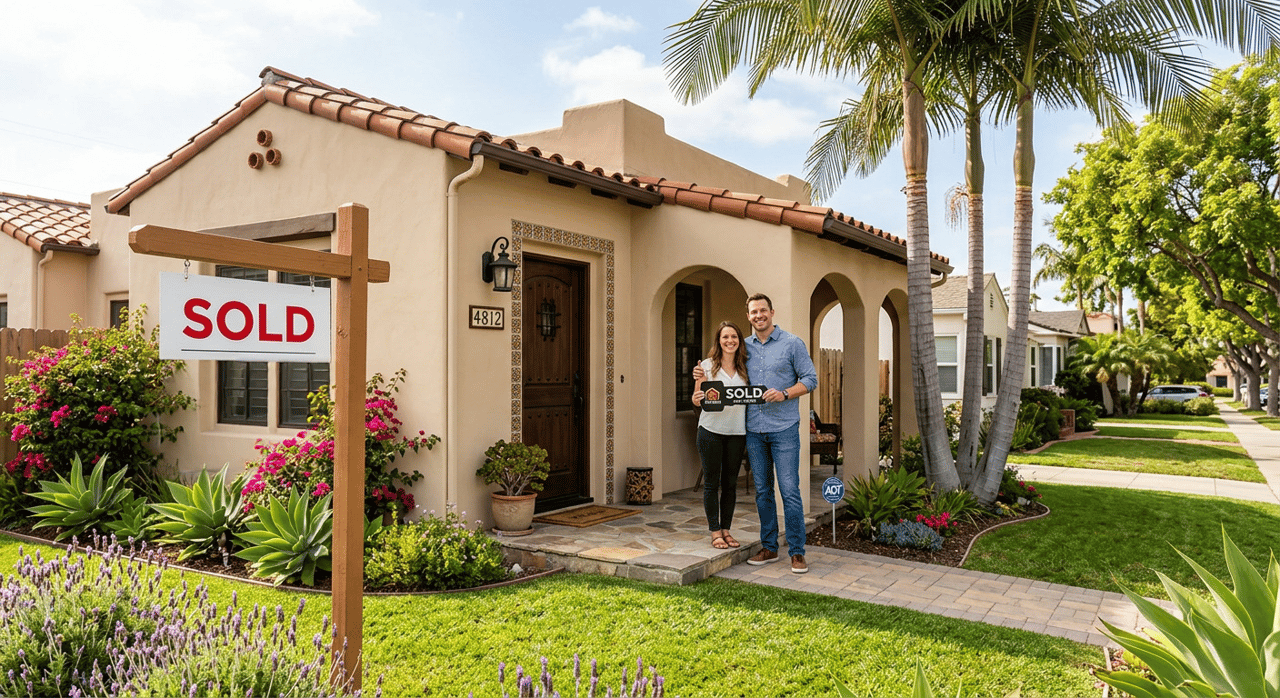
Buying a Home in San Diego With 7% Mortgage Rates: 7 Strategies That Actually Lower Your Payment (2026)
Buyer Resources Alyssa L. Davies October 26, 2026
Buyer Resources Alyssa L. Davies October 26, 2026
If you've been watching mortgage rates climb this fall and wondering whether buying a home in San Diego still makes sense, you're not alone. The average 30-year fixed rate reached 7.40% in mid-October, the highest level since late 2023 and well above the roughly 6.3% buyers saw a year ago. The good news: a high rate is not the same as a closed door. Smart buyers in San Diego County are using a handful of proven tools to lower their payment, reduce cash to close, and stay competitive.
Here's a plain-English look at where the market stands and seven strategies we use with our clients across East County, Chula Vista, North County, and Coastal San Diego.
Even with rates above 7%, the market has not fallen apart, but it has changed in ways that favor prepared buyers. Here is what the September 2026 MLS data shows for residential homes:
Median sales price: $845,000, up 1.8% from a year ago
Months of inventory: 3.9 months, down 7.1% from last year but well above the 1 to 2 months of supply buyers faced in 2021 and early 2022
Median days active on the market: 23 days, down 8.0% from last year
Median percent of original price received: 98.5%, up 0.3% from last year
Prices are holding steady rather than dropping. That means waiting for a big price drop is a gamble. But a median sale at 98.5% of the original list price tells us buyers are typically negotiating about 1.5% off where homes first hit the market, and with inventory well above the ultra-tight levels of a few years ago, you have more homes to choose from than buyers did in 2021 and 2022.
What We're Seeing Firsthand at NewTown Real Estate
Numbers tell part of the story. Here is what we are seeing in our own transactions: with higher rates, there is noticeably less buyer competition than a year ago. Fewer buyers means fewer multiple-offer situations, more homes to choose from, and more room to negotiate. Sellers know buyers are payment-sensitive, so they are more open to creative terms than they were when rates were lower.
That is why we are getting creative with credits and buydowns to help buyer affordability, and why many buyers who also need to sell a home now have a real chance of getting a contingent offer accepted. The strategies below are the ones we are using right now.
Let's use a simple example. On a $900,000 home with 20% down, your loan is $720,000. Here is the principal and interest payment at different rates (taxes, insurance, and HOA are extra):
At 7.4%: about $4,985 per month
At 6.9%: about $4,742 per month
At 6.4%: about $4,504 per month
That one-percentage-point gap is nearly $480 a month, or about $5,800 a year. It's exactly why a strategy that reduces your effective rate, even temporarily, can make a real difference.
A temporary buydown, often called a 2-1 buydown, lowers your interest rate for the first two years. With a 2-1 buydown on a 7.4% loan, your rate would be 5.4% in year one, 6.4% in year two, and 7.4% from year three on. On our $720,000 example, that saves about $940 a month in year one and about $480 a month in year two, roughly $17,000 in total.
The money for the buydown is typically funded by the seller (or sometimes a builder) and held in escrow, and you are generally qualified at the full note rate, so you still need to qualify at 7.4%. This can be a smart way to ease into homeownership if you expect your income to grow or plan to refinance when rates fall.
Seller credits (also called seller concessions) let the seller pay part of your closing costs, prepaid items, or discount points. Limits depend on your loan type, so always confirm with your lender:
Conventional (primary residence): 3%, 6%, or 9% of the price depending on how much you put down (3% with a smaller down payment, 6% with 10% down, 9% with 25% or more down)
FHA: up to 6% of the sales price
VA: 4% for items VA defines as concessions, plus ordinary seller-paid closing costs and reasonable discount points treated separately
Investment property (conventional): 2%
On a $900,000 purchase with 20% down, a 6% credit limit means up to $54,000 in potential seller help, far more than most buyers need. The key is that credits only work when the numbers make sense for the seller, which is why pricing and presentation of your offer matter so much.
Permanent buydowns, or "points," let you pay upfront to lower your rate for the life of the loan. One point costs 1% of your loan amount ($7,200 on a $720,000 loan). Whether it pays off depends on how long you keep the loan. If you plan to stay at least five to seven years, points can make sense; if you might sell or refinance sooner, a temporary buydown or credit may be the better fit. Ask your lender for a break-even calculation before you decide.
Assistance programs help you keep more cash in your pocket and can improve your monthly numbers. Two places to start:
CalHFA MyHome Assistance offers up to 3.5% of the purchase price (with an FHA first mortgage) or up to 3% (with conventional, VA, or USDA) toward down payment and closing costs. It's a deferred-payment loan for first-time buyers (no owned and occupied home in the past three years) who complete a homebuyer education course and meet county income limits. Learn more at CalHFA.ca.gov.
San Diego Housing Commission (SDHC) administers several first-time buyer programs for the City of San Diego, the County, and the City of Chula Vista, including deferred loans for down payment and closing costs for qualifying households. Income and purchase-price limits apply and change periodically. Explore current options at SDHC.org.
If you're a first-time buyer in Chula Vista or East County, these programs can be especially powerful because purchase prices there are often closer to program limits than in coastal ZIP codes. See how prices compare in our El Cajon neighborhood guide.
If a seller has an older FHA or VA loan at a rate in the 2s, 3s, or 4s, you may be able to take over that loan and its rate instead of getting a new 7%+ mortgage. The tradeoff is that you need to cover the gap between the sale price and the remaining loan balance, through cash, a second loan, or a combination. It isn't right for every buyer, but when it works, the savings can be dramatic. We've helped clients through this process, and you can read the full breakdown in our assumable loans guide for San Diego.
If you're active duty or a veteran, a VA loan can allow you to buy with no down payment and no monthly mortgage insurance, which helps offset a higher rate. VA loans also allow seller-paid closing costs and have no minimum credit score set by VA itself (lenders set their own overlays). Review benefits at VA.gov, and see our VA loan and PCS guide for San Diego for local tips.
If you need to sell your current home before you can buy, this market is friendlier than it has been in years. When bidding wars were common, an offer contingent on the sale of your home was often the first one tossed aside. With less buyer competition, sellers are more willing to consider contingent offers, especially when the offer is strong in other ways.
A few ways to make a contingent offer more attractive: get a firm pre-approval before you shop, price and prepare your current home so it sells quickly (ideally list it before or at the same time you start offering), keep your contingency timeline reasonable, and ask your agent whether a "kick-out clause" makes sense. A kick-out clause lets the seller keep marketing their home and, if a better offer comes in, give you a short window to remove your contingency or step aside. It gives the seller comfort and gives you a shot at a home you love. If you're a move-up buyer or a seller who also needs to buy, reach out before you list, because the order and timing of the two transactions matters.
Nobody can time rates perfectly. Right now there is less buyer competition and more room to negotiate. If rates drop, many buyers will rush back in, which can increase competition and push prices up. If you buy now with a smart structure (such as a seller-paid buydown or credit), you can potentially refinance later if rates improve, while still building equity in the meantime. The right answer depends on your timeline, savings, and comfort with the payment, and that is a conversation worth having with a local agent and lender before you decide. Our step-by-step guide to buying a home in San Diego walks through the full process from pre-approval to closing.
What are mortgage rates in San Diego right now? Mortgage rates are set nationally and vary by lender, credit score, and loan type. The national 30-year fixed average was about 7.40% in mid-October 2026. Get a fresh quote from a lender before making an offer, since rates change weekly.
What is a 2-1 buydown and who pays for it? A 2-1 buydown temporarily lowers your interest rate by 2 points in year one and 1 point in year two. It's usually funded by the seller (or builder) as part of the negotiation and held in escrow. You are generally qualified at the full note rate.
How much can a seller contribute toward my closing costs? It depends on your loan: up to 6% for FHA, 4% for VA-defined concessions, and 3% to 9% for conventional primary residences depending on down payment. Confirm limits with your lender.
Can first-time buyers get down payment help in San Diego? Yes. CalHFA's MyHome Assistance and several San Diego Housing Commission programs offer deferred loans to qualifying first-time buyers. Income, price, and education requirements apply.
Is it better to wait until rates come down? It depends on your situation. Waiting can mean more competition and potentially higher prices if rates fall. Many buyers choose to buy now with a strategy to refinance later. A local agent and lender can help you run both scenarios.
Can I make an offer on a home before I sell my current one? Yes. With less buyer competition right now, contingent offers have a better chance of being accepted than they did in the multiple-offer market. A strong pre-approval, a realistic contingency timeline, and possibly a kick-out clause can help. Talk with your agent about timing before you list.
Do these strategies work in every part of San Diego County? Yes, though the best approach varies by area. In more affordable East County and Chula Vista, assistance programs often fit well. In North County and coastal areas, where prices run higher, buydowns and credits can be especially useful.
Buying in a 7% rate environment takes strategy, not luck. The NewTown Real Estate team helps San Diego buyers compare loan options, negotiate credits and buydowns, and find assistance programs they qualify for, whether you're a first-time buyer, a military family, or relocating from out of state. Call us at (619) 404-2492 or reach out through our contact page for a no-pressure conversation about your goals. Building client wealth through guidance and education is what we do.
Stay up to date on the latest real estate trends.
Buyer Resources
Rate buydowns, seller credits, contingent offers, and down payment assistance: how San Diego buyers are making the numbers work this fall

Relocation
Home prices, neighborhoods, schools, the pier, Camp Pendleton, and what buyers should know before moving to Oceanside

Military
Buying 2-4 units with zero down, house hacking with ADUs and garage conversions, temporary housing, and the best neighborhoods near every base, from the fleet to Camp … Read more

Home Buying Tips
How to take over a seller's low mortgage rate, cover the equity gap, and navigate the loan assumption process in San Diego
Neighborhood Guide
Home prices, schools, downtown revitalization, and everything to know about East County's most affordable major city

Market Update
San Diego’s housing market is shifting, but limited inventory and strong demand continue to set it apart from markets experiencing sharper declines.
Relocation
Home prices, schools, landmarks, and everything to know about one of San Diego’s oldest neighborhoods
Relocation
Everything you need to know about living in La Jolla in 2026, from home prices and neighborhoods to schools, beaches, and what makes this iconic San Diego community on… Read more

Market Update
How global events, mortgage rates, and local housing trends are shaping today's market.